Ingredients
Instructions
Full Article
What Chili is to America, Stewed Beef Brisket is to the Cantonese world.
It’s a dish, yes. A tasty and much beloved one, for sure. But Chili would not have the cultural cachet it does today without chili fries, chili mac, chili dogs, and (everybody’s favorite) chili-over-spaghetti. It’s as a sauce that the versatility of the thing shines, and Cantonese Stewed Beef Brisket isn’t all that much different.
Case in point: in Steph’s hometown of Zhaoqing, not far from where she grew up, there’s an old, much beloved restaurant called Zi Wan Geoi (梓云居). It’s a rice noodle and brisket joint — there are many like it in Guangdong, but this one was theirs:
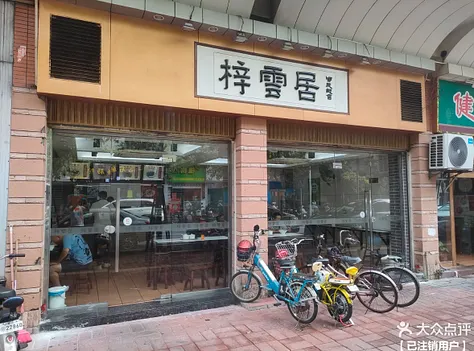
Apologies for having to grab these from Dianping, we neglected to take photos last time we were there.
The menu (top center), has a few choices, but revolves around the stewed brisket. You can get the brisket over top of rice noodle rolls, horfun rice noodles, maifun rice noodles, laaifun rice noodles or… noodle-noodles. It can be topped over soup noodles (top right), or it can be smothered over fried noodles (bottom right).
When Steph was young, she’d pass Zi Wan Goei coming home from school. With only a a couple yuan in her pocket, she couldn’t afford a noodle topped with big hunks of stewed meat — no matter how tempting the scent of the beef wafting into the narrow streets happened to be. But luckily, there was also a solution for those in her shoes, and an illustrative one at that: the noodles could equally be smothered with solely the stewing sauce, sans meat.
So today? We’ll cover two things: first, of course, how you can make a pot of Cantonese stewed brisket (ala the video above). But after that, we’ll also show you how to use said brisket as a topping for a variety of Cantonese dishes — which is perhaps, I think, really the true essence of the thing.
Cantonese Stewed Beef Brisket (牛腩煲)
The following recipe makes a large pot that can serve as a centerpiece for a Cantonese meal.
In a small bowl, soak
- 1 chenpi (陈皮), dried and aged tangerine peel
for ~30 minutes. Once pliable, scrape off the bitter white pith with a knife. Set aside.
In a bowl, mix:
- 2.5 tbsp Minsi Paste (面豉) 1
- 1 psc Red Fermented Tofu (南乳)
- 1 tbsp Sesame Paste (芝麻酱) -or- Peanut Butter
- ½ tbsp Hoisin Sauce
- 1 tbsp Sugar
- 1 tbsp Water
and set aside.
Prepare the aromatics. Smash
- 4 cloves garlic
and slice
- 2 shallots
- 1 inch ginger
and set aside.
Slice
- 1 kg beef brisket (牛腩) -or- plate (坑腩)
into one inch cubes.
In a dry oil-less wok, toast the beef over a medium flame for ~8 minutes, or until the edges start to brown. Remove and roughly rinse the wok. Add
- 2 tbsp peanut oil
and fry the garlic, shallot, and ginger over a medium flame for ~45 seconds, or until the garlic begins to brown. Swap the flame to low, scooch the aromatics to the side, then add in the sauce. Mix well, then swirl in another
- 1 tbsp peanut oil
and continue to fry for ~2 minutes, or until the oil has separated from the sauce. Add in the toasted beef, swap the flame to high. Fry the beef in the sauce for ~1 minute, or until the beef is well coated. Swirl
- 1 tbsp liaojiu a.k.a. Shaoxing wine
over spatula and around the sides of the wok. Add
- ~1.5 liters hot, boiled water (or enough to submerge the beef by ~1/2 inch)
- 1 star anise (八角)
- ½ cinnamon stick (桂皮)
- ½ tsp fennel seed (小茴香)
and the soaked/scraped tangerine peel from above. Bring to a boil and, then shut off the heat. Transfer to a stewing vessel, if using. Simmer over medium-low for ~2 hours, or until the beef can be easily poked through with a chopstick.
Season with:
- 1 tsp sugar
- ½ tsp salt
- ¼ tsp MSG
and optionally sprinkle over a bit of chopped Chinese celery.
Toppingification: A Rough Guide
Below are four possible topping choices, all quite classic in Guangdong. It’s by no means exhaustive. This stew is extremely versatile — you can really top the stuff on practically anything. For example, the other day we added a bit into some freshly baked banh mi- ish 2 style baguettes together with scallion and a nice smear chili oil furu (fermented tofu). It was… actually pretty incredible, would definitely recommend as well:
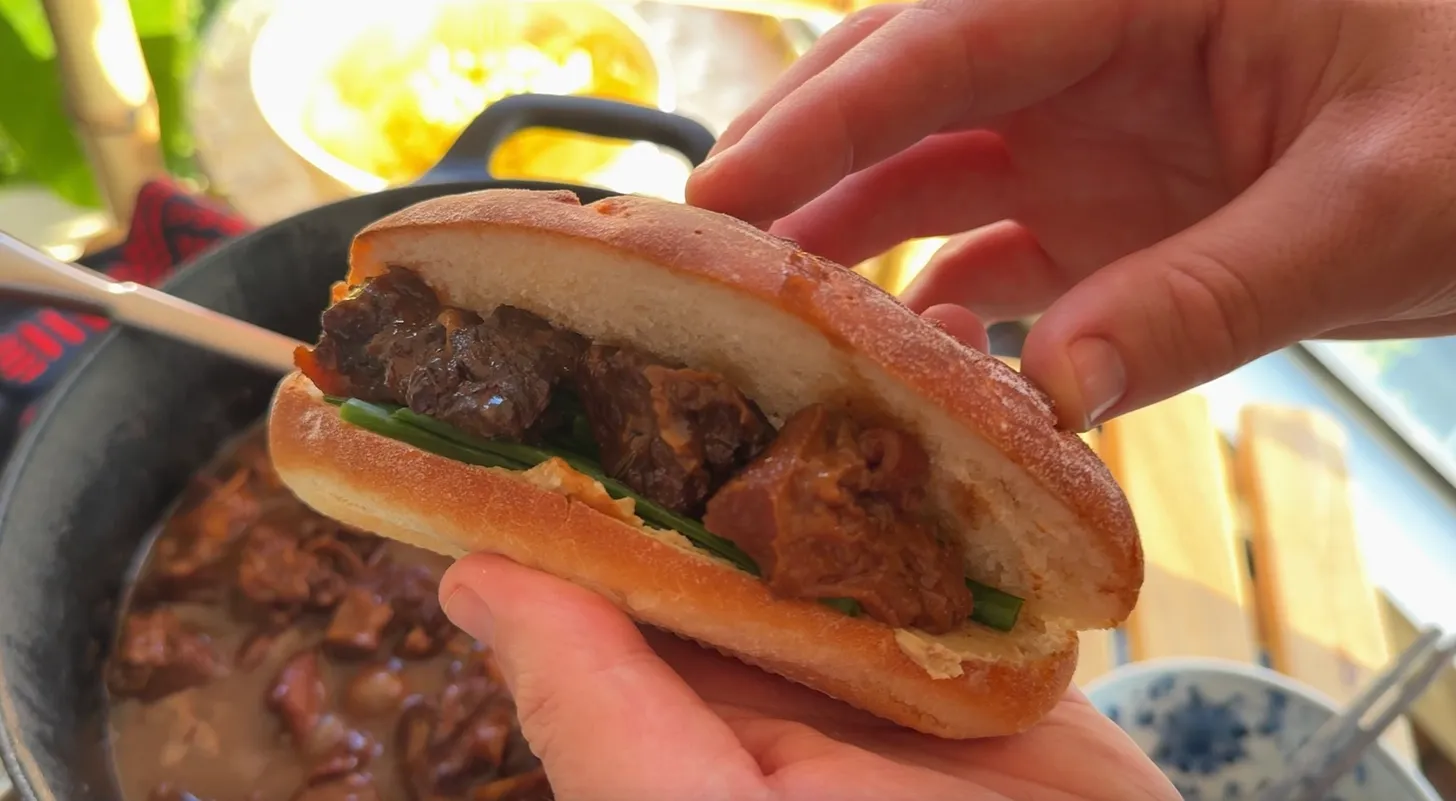
Apologies for the mediocre picture, it was quite sunny on our balcony that day.
But for a few more culturally-relevant Cantonese options…
Brisket Lo Mein
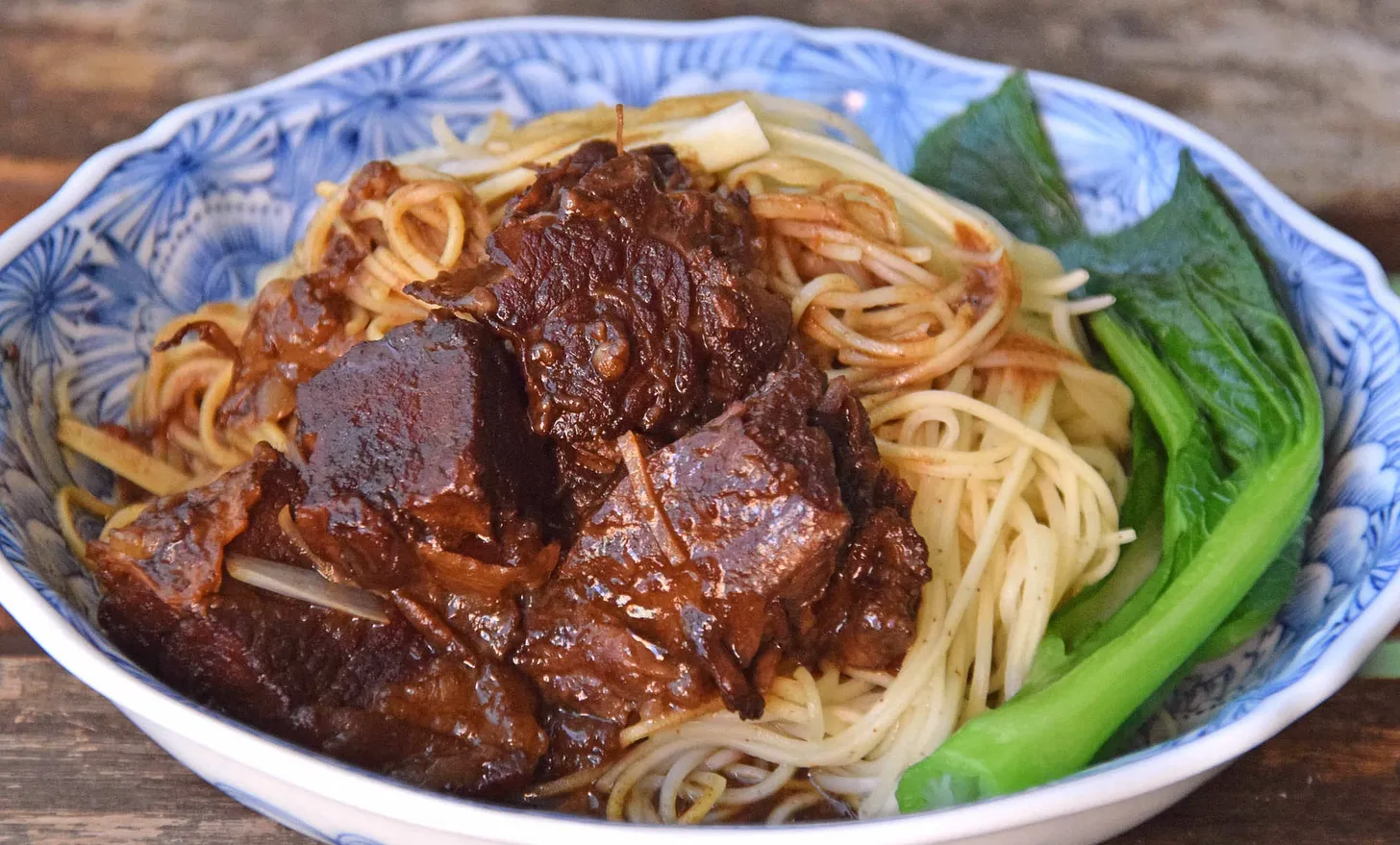
Makes one serving.
Add
- ½ tsp salt
- ½ tbsp peanut oil
to a pot of boiling water. Boil
- 80g dried wonton noodles
until done. Remove, drain, and jiggle the noodles with a pair of chopsticks to release the excess steam.
In a bowl, mix with
- 1 tbsp lard, preferably -or- peanut oil
- 2 tbsp of the beef stewing liquid
Top with three generous spoonfuls of the stewing beef (and a little extra sauce never killed anyone).
Brisket Rice Noodles
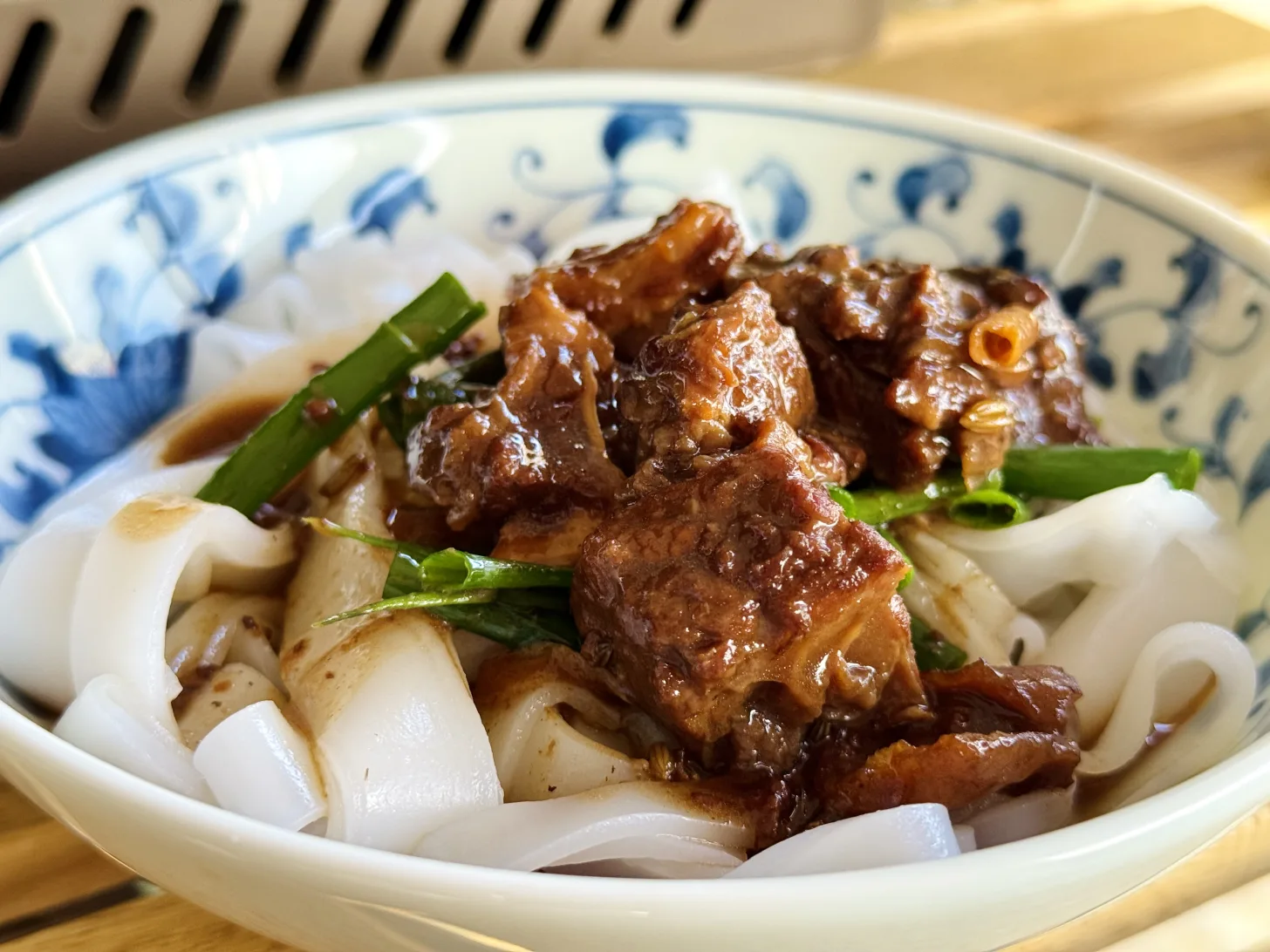
Note: Different rice noodles will need to be cooked differently. Given that one of the most common rice noodles in grocers worldwide are dried Vietnamese rice noodles, we went with pho noodles below.
Regardless of the noodles you choose, simply cook them until done. The noodles in the above picture are a Yunnan sort called ‘Juanfen’ (卷粉), which only need a quick hot water soak to be ready to eat.
Makes one serving.
Add
- ½ tbsp peanut oil
to a pot of boiling water. Boil
- 100g dried Pho noodles (or your rice noodle of choice, see note above)
until cooked. Strain.
In a bowl, mix with
- 1 tbsp peanut oil
- 1 sprig scallion, cut into ~1.5 inch sections
Top with three generous spoonfuls of the stewing beef (and a little extra sauce never killed anyone).
Brisket Macaroni Soup Noodles
Note: This will require making a rough stock base. If you already have a Chinese stock handy, definitely use that — below is a quick Chacaanteng-style compound stock, but a beef stock would also be nice here. A western style stock could also be used so long as you didn’t go extremely heavy with the western herbs when making it.
To make the stock, first soak
- 1 kg chicken scraps or pork scraps, or a mixture
in cool water for one hour. Then add the meat to cool water, bring to a boil. Boil for 2-3 minutes, remove the meat and rinse under running water.
To a pot, add the meat together with
- 2 tbsp liaojiu a.k.a. Shaoxing wine
- ~2 inches of ginger, smashed
- 1 large sprig scallion, tied in a knot
- 3 liters cool water
Bring up to a boil and down to a simmer, and simmer on low for three hours. Reserve — this will make more than you need for the recipe.
In a separate pot of water, add
- ½ tsp salt
and boil
- 60g dried macaroni
until about al-dente, about ~7 minutes. Strain and reserve.
In a saucepan, add
- 400mL stock
- 2 tbsp beef stewing liquid
- ⅛ tsp salt
- ¼ tsp sugar
- ¼ tsp chicken bouillon powder
- ¹⁄₁₆ tsp MSG
- ⅛ tsp white pepper powder
and bring to a boil. Add in the macaroni and cook together for about 1 minute, or until the macaroni is cooked through. Transfer to a bowl, and top with three generous spoonfuls of the stewing beef (and a little extra sauce never killed anyone).
Blanched Lettuce with Brisket
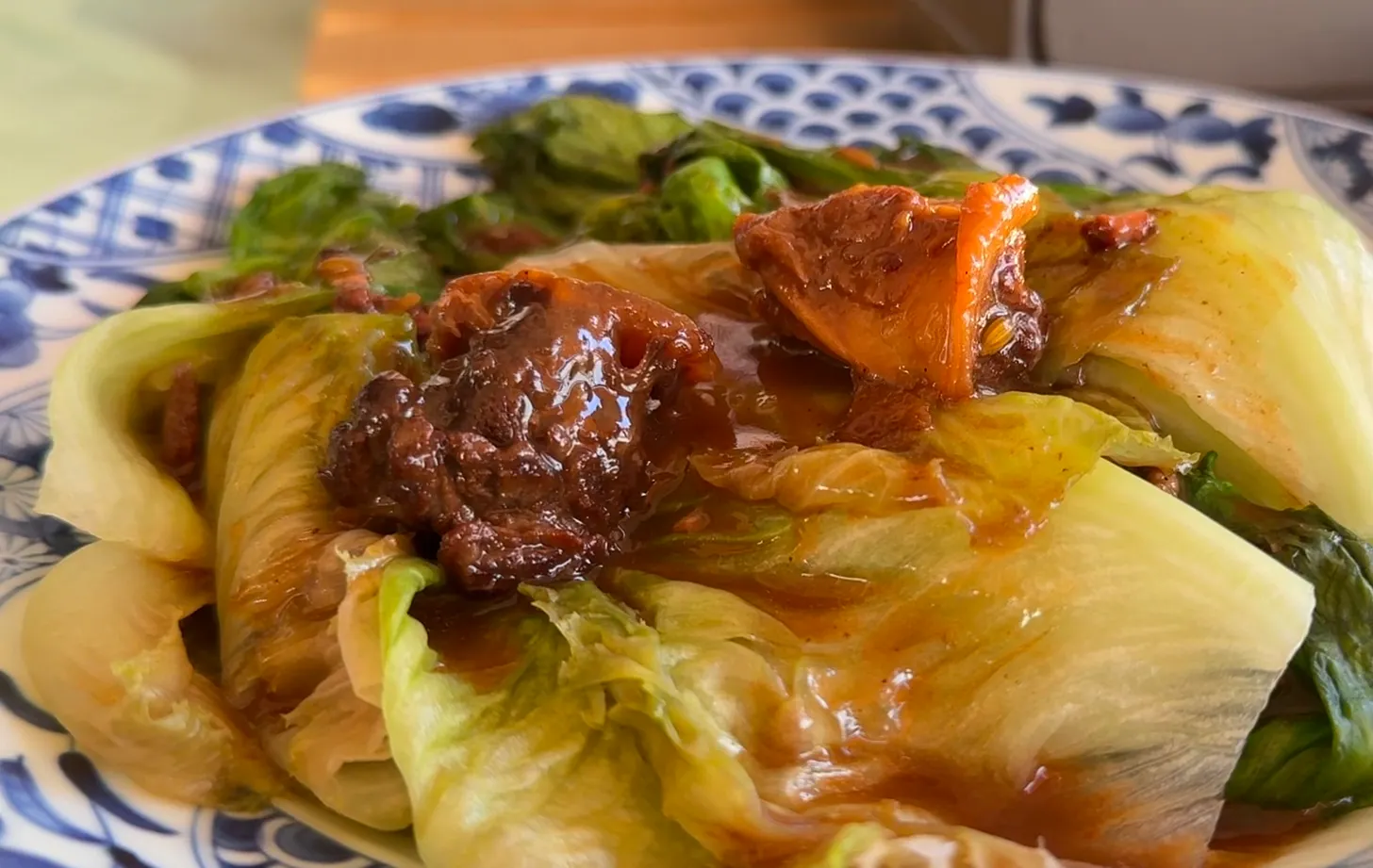
Get a pot of water up to a boil and add
- ½ tsp salt
- ½ tbsp oil, optional
once dissolved, add:
- 400g romaine lettuce (生菜)
It should be done after a quick mix. Remove the lettuce, strain, and transfer to a plate. Drain out any excess water, then add:
- ~3 tbsp beef stewing liquid
- 2 generous spoonfuls of stewed beef